Some card games are about planning. Egyptian Rat Screw (ERS) is about noticing—fast. It’s the kind of game where a single blink turns into regret, because the table doesn’t wait for you to catch up. The rules are simple, the pace is not, and the fun comes from the same place as any good party game: everyone is sure they’re paying attention, right up until they aren’t.
What makes ERS special is that it blends two mini-games into one: a steady rhythm of flipping cards, and sudden slap moments where speed and accuracy matter more than perfect memory.
What you’re trying to do
The goal is to win all the cards. You do that by collecting piles through two main routes:
-
Winning a face-card challenge (a built-in battle system)
-
Correctly slapping the pile when certain patterns appear
Both routes reward the same thing: being alert at the exact right time.
Setup and dealing
Use a standard 52-card deck. Deal all cards evenly among players. Everyone keeps their stack face down; you don’t look through it.
Players take turns placing the top card of their stack face up onto a single shared pile in the center. Most groups play clockwise, but direction doesn’t really matter as long as it stays consistent.
The basic rhythm of play
On your turn, you flip exactly one card onto the center pile. If nothing special happens, play continues to the next player.
The “special happens” part is where ERS becomes ERS.
Face-card challenges (the engine that prevents endless flipping)
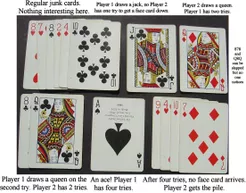
When a face card appears, the next player must respond by flipping a limited number of cards to “answer” the face card.
A common challenge structure:
-
Jack → next player gets 1 chance
-
Queen → 2 chances
-
King → 3 chances
-
Ace → 4 chances
If the challenged player flips a face card within those chances, the challenge resets and flips direction to the next player (because the new face card now demands an answer).
If the challenged player fails to reveal a face card in time, the player who laid the original face card wins the entire center pile and adds it to the bottom of their stack.
This rule keeps the game from drifting into a slow parade of single flips. Face cards create sudden stakes.
Slapping rules (the part everyone argues about)
Slapping is what most people remember—and what causes the most confusion if you don’t define it clearly first.
In ERS, when a recognized pattern appears on the center pile, anyone can slap it. First correct slap wins the pile.
Common slap patterns include:
-
Double: two cards of the same rank in a row (7, 7)
-
Sandwich: same rank with one card between (7, 3, 7)
-
Runs (optional): three consecutive ranks like 4, 5, 6 (often allowed, but not universal)
Pick your slap rules before the first deal. ERS is fast, and fast games punish vague agreements.
What happens after a winning slap
The slapper takes the entire center pile and places it face down under their stack (usually at the bottom). Then the next player in turn order starts a new pile by flipping a card.
If the pile is won during a face-card challenge, the winner collects it the same way and play continues with a fresh pile.
Penalties for bad slaps (and why they matter)
If you slap when the pile does not match a valid pattern, you pay a penalty. The most common penalty is placing one card (sometimes two) from your stack face up into the center pile.
Penalties do two things:
-
They stop people from slapping wildly and turning the game into pure flailing.
-
They add risk, which makes correct slaps feel earned.
Playing ERS as a two-player game
ERS is often associated with groups, but it can work as 2 player card games surprisingly well. The main difference is intensity: with only two players, every slap is a direct duel and face-card challenges happen more frequently between the same two people.
Two-player tip that keeps it fair: agree on a clear “first contact” rule. Is the slap counted when a hand touches the pile, or when the hand fully rests on it? Tiny detail, big peacekeeper.
Variations you’ll see (keep it simple)
ERS has local dialects. Instead of collecting every variation, focus on the few that actually change the feel:
-
Whether runs count as slaps
-
Whether top-and-bottom (first and last visible card match) counts
-
How harsh false slap penalties are
If your group is new, fewer slap rules usually makes the game smoother and less argumentative.
A small real-table insight beginners miss
Most people think ERS is purely reflex. It’s not. The real advantage comes from staying calm during boring stretches. Beginners get restless, start slapping on “almost doubles,” and bleed cards through penalties. The steady player who slaps less—but slaps correctly—often wins more piles without even looking dramatic doing it.
That’s the weird truth of ERS: the fastest hand isn’t always the best hand. The most accurate hand usually is.
Egyptian Rat Screw (ERS) is a simple structure with chaotic moments: flip cards, survive face-card challenges, and steal piles with clean, correct slaps. Once your table agrees on slap patterns and penalties, it becomes one of the most replayable fast card games around—part rhythm, part reaction, and entirely unforgiving in the funniest way